Custom Granite Markers for Pets: A 2026 Guide
Table of Contents
Custom Granite Markers for Pets: What Actually Matters
Flat Markers vs Monument-Style Granite Pet Headstones
Pet Memorial Engraving Ideas: Names, Dates, and Heartfelt Messages
Paw-Print Icons, Decorative Designs, and Personalized Engraving
Pet Memorial Stone With Photo: Getting the Detail Right
Outdoor Pet Memorial Stone: Weather Resistance and Placement
Garden Memorial, Cemetery Placement, and Indoor Display
Marker Dimensions, Stone Thickness, and Weight
How to Choose a Size Based on Viewing Distance
Preparing the Site Before the Stone Arrives
Pricing, Production Timelines, and Care
What Drives the Price of a Custom Granite Marker
Production Timelines and Proof Approval
Cleaning, Sealing, and Long-Term Care
Frequently Asked Questions
Last Updated: October 12, 2026
Custom Granite Markers for Pets: What Actually Matters
Custom granite markers for pets are permanently engraved stone memorials made from solid granite, sized and shaped for a garden, grave site, or indoor display. At Memorials Direct, we design these pieces one-on-one with pet owners, and the questions we hear most are about durability, size, and cost. This guide answers them in plain terms.
Granite is the material most cemeteries and memorial designers reach for because it resists frost, rain, and sun without fading. The American Kennel Club's guidance on pet loss and memorials notes that memorializing a pet can be an important part of grieving, which is why the details below matter more than they might seem.
Below, we cover the marker shapes worth considering, how engraving and photo panels work, what drives the final price, and how to prepare a site before the stone arrives.
Flat Markers vs Monument-Style Granite Pet Headstones
The main format we offer is flat markers, which sit level with the ground. Flat markers suit garden beds and cemetery sections with height restrictions.
Which Shape Fits Your Garden, Grave Site, or Shelf
Flat marker: best for lawn-level garden placement, low-profile cemetery rules, and shelf display indoors.
Pet Memorial Engraving Ideas: Names, Dates, and Heartfelt Messages
A strong pet memorial engraving combines three elements: the pet's name, the memorial dates, and one heartfelt message that sounds like you. Everything else is decoration.
Start with the name exactly as you said it. If your dog answered to "Biscuit" rather than "Mr. Biscuits," engrave Biscuit. For the dates, most owners use birth and passing years, and some add a single line such as "Waiting at the door since 2011."
Paw-Print Icons, Decorative Designs, and Personalized Engraving
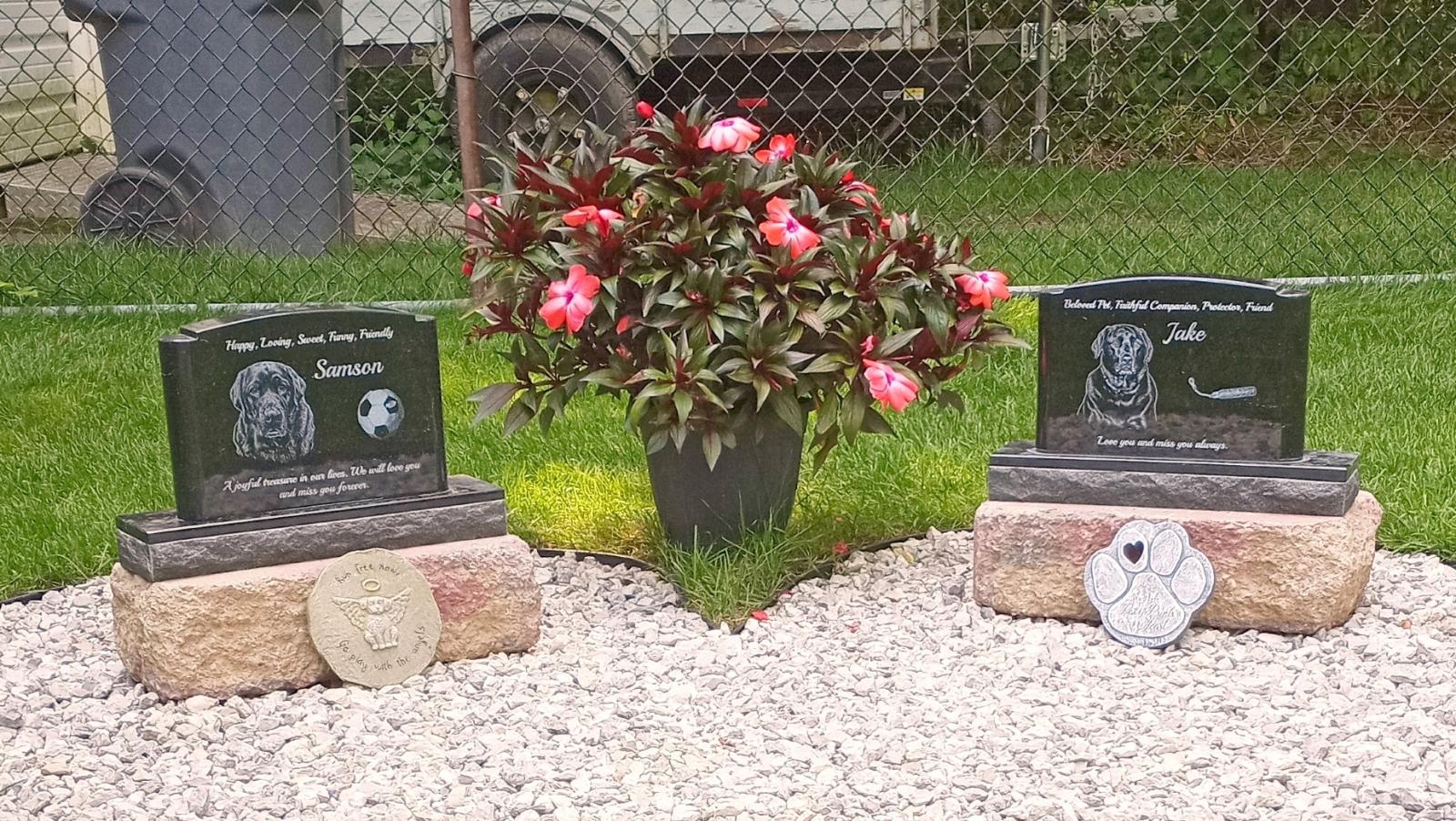
Icons and borders carry the emotional weight that text alone can miss. Popular choices include a paw-print icon, a silhouette of your pet's breed, a favorite toy, or a simple wildflower border.
What most guides miss is restraint. A stone crowded with five fonts and three icons reads as noise from two metres away. Pick one icon and one border, and let the name carry the piece.
Pro Tip Send us a photo of your pet's actual paw print, taken on paper with an ink pad, and we can engrave the real print rather than a generic paw icon.
Pet Memorial Stone With Photo: Getting the Detail Right
A pet memorial stone with photo uses a laser-etched image panel, and the quality of the result depends almost entirely on the photo you send. Sharp, well-lit images with a clear subject etch far better than blurry phone snaps.
Photo engraving works by burning the image into the granite surface at high resolution. Black granite gives the strongest contrast for portraits; lighter granites produce a softer, more muted result.
For the best result:
Choose a photo where your pet's face fills much of the frame
Avoid heavy shadows across the eyes and nose
Send the original file, not a screenshot or a photo of a photo
Outdoor Pet Memorial Stone: Weather Resistance and Placement
An outdoor pet memorial stone survives decades of weather when the granite is solid and the engraving is cut into the stone rather than painted on. Placement matters just as much as material: water pooling around the base causes more damage than rain falling on the face.

Garden Memorial, Cemetery Placement, and Indoor Display
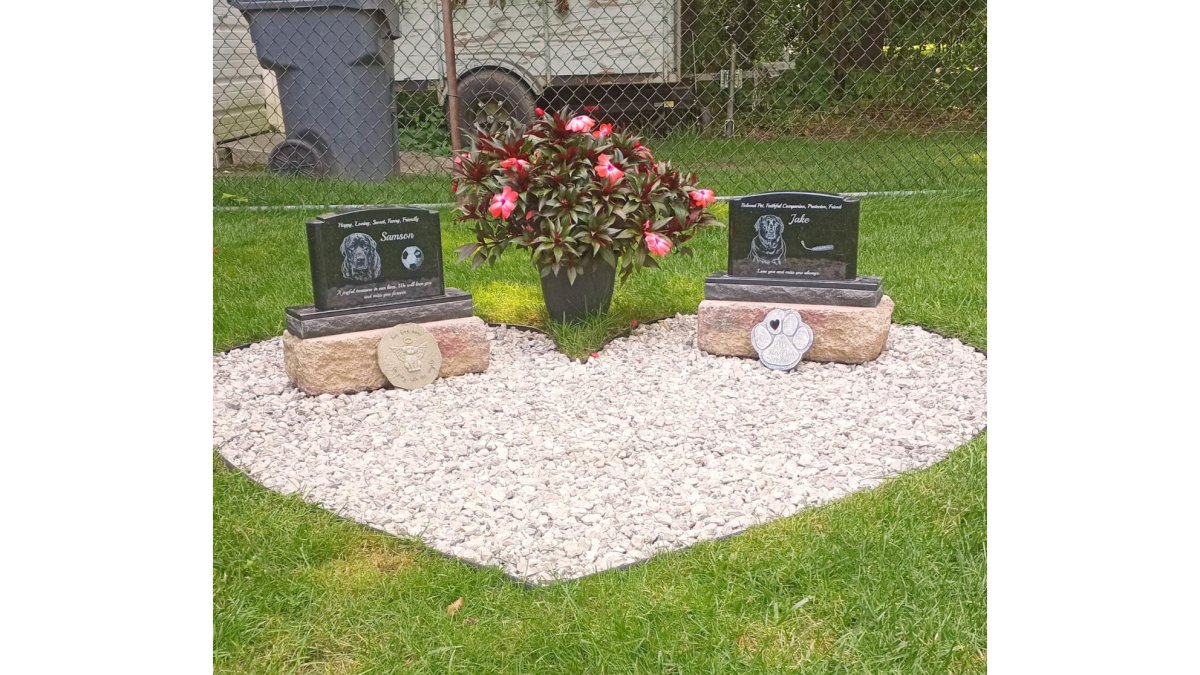
Where you place the stone changes what you should buy. A garden memorial sits in a planting bed or beneath a tree, a cemetery placement follows the site's written rules, and an indoor display keeps a smaller, lighter stone on a shelf or mantel.
For garden placement, set the marker on a compacted gravel or sand base so it does not sink unevenly. For a grave site, confirm the permitted dimensions before ordering. Indoors, a smaller flat marker or river rock style works well because weight matters less and the surface stays protected.
The Royal Horticultural Society's advice on garden landscaping and hard materials is a useful reference for preparing a stable garden base.
Marker Dimensions, Stone Thickness, and Weight
Marker dimensions, stone thickness, and weight decide how a memorial is installed, shipped, and displayed. A heavier stone stays put outdoors but needs help to move; a lighter one is simple to reposition but suits indoor or sheltered use. The table below gives typical ranges to plan around, not exact product specs.
Format | Typical Face Size | Typical Thickness | Typical Use | Handling |
Small flat marker | 6-10 in wide | 1-2 in | Indoor display, shelf | One person can lift |
Standard flat marker | 12-24 in wide | 2-4 in | Garden bed, grave site | Two people, no machinery |
Slant marker | 16-24 in wide | 3-4 in | Garden border, grave site | Two people, base prep needed |
Monument-style | 12-24 in wide, 16-30 in tall | 4-6 in plus base | Grave site, memorial garden | Needs a base and a plan |
Ask for the exact dimensions and weight before you order, especially if you are installing it yourself. A stone that looks modest online can still be heavier than expected once it is solid granite.
How to Choose a Size Based on Viewing Distance
The right size depends on how far away people will stand when they read it:
Indoor shelf or mantel: a small flat marker is enough. The viewer is close, so fine engraving reads well.
Garden bed viewed from a path: a standard flat marker works. Aim for lettering at least 1 inch tall so it reads from a few feet away.
A common mistake is ordering a stone that is beautiful up close but unreadable from where visitors actually stand. Measure the viewing distance first, then choose the format.
Preparing the Site Before the Stone Arrives
Installation quality affects how the stone sits for years. A few practical steps:
Garden placement: set the marker on a compacted gravel or sand base so it does not sink unevenly. Level the base before setting the stone.
Cemetery placement: confirm the permitted dimensions, base requirements, and any height limits in writing before ordering. A stone that violates the rules may not be permitted.
Indoor display: use a felt pad or rubber feet under a flat marker to protect the shelf and prevent scratching.
Drainage: make sure water does not pool around the base. Standing water causes more damage than rain falling on the face.
The Royal Horticultural Society's advice on garden landscaping and hard materials is a useful reference for preparing a stable garden base.
Measure the viewing distance, check the cemetery rules in writing, and prepare a level, well-drained base before the stone arrives. Those three steps prevent most installation problems.
Pricing, Production Timelines, and Care
Most pet memorial listings show a product photo and a 'contact us' button, which leaves owners guessing what actually drives the final price. Here is the honest breakdown of the factors that move a custom granite marker quote up or down, plus how to care for the stone once it is in place.
What Drives the Price of a Custom Granite Marker
Five variables account for nearly all of the price difference between one marker and another:
Size and thickness. A small flat marker for a shelf uses a fraction of the granite of a monument-style stone with a base. Doubling the face area does not double the price, but it moves the stone into a different shipping and handling class.
Granite color and origin. Absolute Black granite produces the strongest photo contrast, so the color choice is both aesthetic and functional.
Engraving complexity. A name, dates, and a single line of text is the base level. Each additional icon, border, or font change adds setup and machine time.
Photo panel. Laser-etched photo panels add a separate production step and require artwork preparation.
Shipping and installation. Granite is heavy. A standard flat marker may ship by parcel carrier.
A common pattern is that the inscription and photo are what owners remember, while the stone size is what they regret skimping on. If the budget is tight, choose a smaller stone with a strong inscription rather than a large stone with a weak one.
Production Timelines and Proof Approval
Production does not start until you approve the final layout proof. The clock begins at approval, not at order. Review the proof for spelling, date format, line breaks, and icon placement, and reply with changes in one pass rather than several. Each round of revisions adds time. If you have a ceremony or anniversary date, tell the designer upfront so the schedule can be planned around it.
Cleaning, Sealing, and Long-Term Care
Granite holds its finish for decades with almost no maintenance, but a few habits extend that life:
Routine cleaning: wash with water and a soft brush or cloth. Mild dish soap is fine for stubborn dirt.
Avoid acidic cleaners: vinegar, citrus, and bathroom cleaners can dull polished surfaces over time.
Bird droppings: rinse them off promptly rather than scrubbing them in. The uric acid is the problem, not the scrubbing.
Sealing:
Winter: in freeze-thaw climates, keep the base clear of standing water so ice does not lift or shift the stone.
Never pressure-wash an engraved photo panel. The force can dull the etched detail permanently, and the damage cannot be reversed.
Keep a photo of the marker and a copy of the approved proof. If the stone is ever damaged or you want a matching piece later, the proof is the fastest way to reproduce the design.
If you are unsure what suits your situation, our team walks you through the options before you commit to anything.
Frequently Asked Questions
How do I choose a granite marker for my pet?
Start with where it will sit. A flat marker suits a garden bed or cemetery plot. Then pick the granite finish, usually polished black granite for photo engraving, and decide on size, inscription, and any paw-print icon or decorative design. Finally, confirm the dimensions and weight so you can move and install it safely. Memorials Direct can walk you through each choice one-on-one.
Can a granite pet marker include a photo?
Yes. A pet memorial stone with photo uses laser engraving to etch the image into polished black granite, which holds detail far better than lighter stones. The best results come from a sharp, well-lit, high-resolution photo with your pet's face clearly visible. Send the original file rather than a screenshot, and ask how the photo panel will be positioned alongside the pet name, memorial dates, and inscription before production begins.
How long do granite pet memorial markers last outdoors?
Granite is one of the most durable stones used for memorials, and a properly sealed marker can hold its engraved detail and finish for decades outdoors. Weather resistance depends on the granite finish, the quality of the engraving, and how the stone is set. A stable base that keeps the marker out of standing water and repeated freeze-thaw movement matters as much as the stone itself. Clean it occasionally with water and a soft brush.
What size should a pet grave marker be?
Size depends on the space and the setting. Small flat markers suit indoor display, garden placement, or a shelf, while larger flat markers fit a grave site or memorial garden. Check any cemetery rules on marker dimensions and stone thickness before ordering, since many have limits. Also weigh the marker before installation: a heavier stone needs a firmer base and help to position it.
Choosing a pet memorial is hard, and getting the details wrong makes it harder. Memorials Direct designs each piece one-on-one with you, from the first sketch to the finished engraving, using permanently etched granite rather than painted lettering. Because we sell directly to you, you get faster turnaround times and a designer who knows your pet's name, not a ticket number. Contact us and we will help you create a memorial that lasts.
Contact Us
Comments